


Smart Toilet Seat Battery Life Uncovered: Lead-Acid vs. Lithium-Ion
Commercial restroom facilities operating at high throughput require hardware that minimizes unscheduled routine maintenance. For facility managers overseeing airports, hospitals, shopping malls, and office towers, the primary failure point in sensor-driven automated sanitary film toilet seats often traces back to power management. Choosing between lead-acid and lithium-ion chemistry directly impacts labor allocation, operational expenditure, and device uptime.
Selecting the right power cell for a commercial automatic toilet seat battery setup determines whether a facility experiences uninterrupted hygienic film replacement or constant battery swap out requests. This engineering analysis evaluates lead-acid and lithium-ion chemistries across cycle life, environmental stability, total cost of ownership (TCO), and custom factory integration for high-volume B2B buyers and sanitary supply distributors.
Battery Chemistry Performance Metrics in High-Traffic Facilities
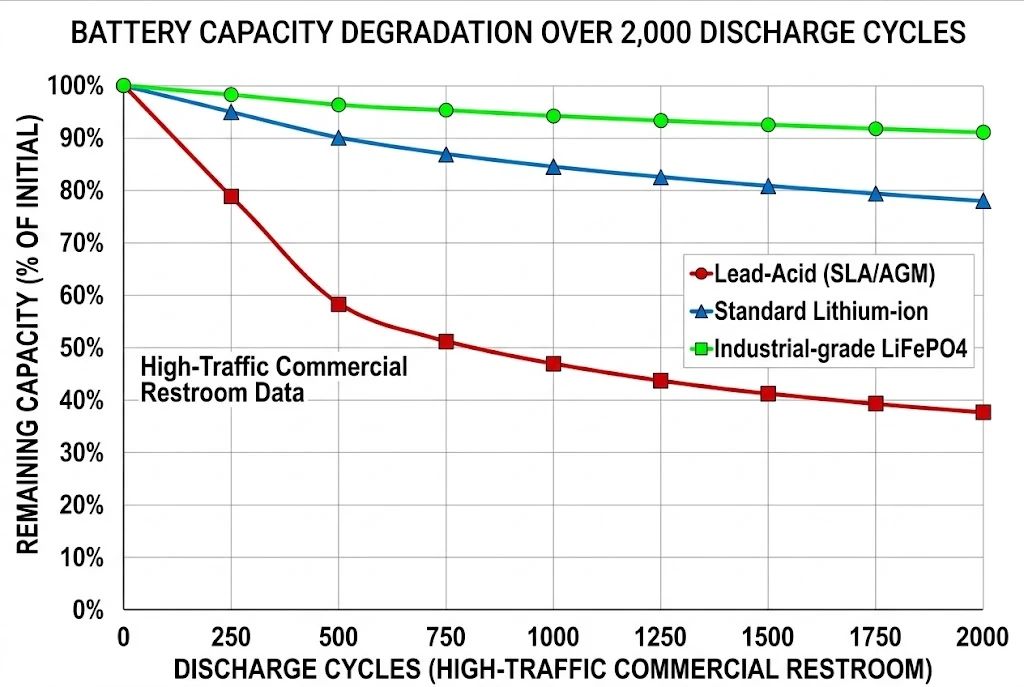
Automated sanitary toilet seats use small DC motors to pull fresh film across the ring upon sensor activation. Each cycle demands immediate peak current. The battery chemistry selected determines how many activations occur before voltage drops below operational thresholds.
BATTERY ARCHITECTURE MATRIX
| Lead-Acid (SLA/AGM) | • Low upfront unit cost | • Rapid voltage drop under load | • High weight (structural strain) | • 300–500 cycle rating |
| Lithium-Ion / LiFePO4 | • Extended operational lifespan | • Flat discharge voltage curve | • Lightweight, high energy density | • 1,500–3,000 cycle rating |
Lead-Acid (SLA/AGM) Capabilities
Sealed lead-acid (SLA) cells historically served as standard secondary power sources due to low initial acquisition costs. However, SLA batteries present distinct physical and chemical constraints in modern commercial restrooms:
Cycle Life
Typically delivers 300 to 500 charge-discharge cycles before original capacity drops below 60%.
Self-Discharge Rate
Loses 3% to 5% of charge per month at ambient room temperature, accelerating in unconditioned utility spaces.
Voltage Sag
Under repeated motor strain, SLA voltage drops sharply, leading to slow film rotation or sensor timing errors long before full chemical depletion.
Lithium-Ion (Li-ion & LiFePO4) Capabilities
Industrial lithium formulations, particularly Lithium Iron Phosphate (LiFePO4), address high-frequency usage profiles through higher power density and discharge characteristics:
Cycle Life
Yields 1,500 to 3,000+ full discharge cycles while retaining over 80% nominal capacity.
Energy Density
Packs three times the energy per gram compared to SLA, enabling smaller battery compartments and cleaner product designs.
Consistent Output
Maintains steady output voltage throughout 90% of the discharge curve, ensuring constant motor speed and film replacement times from full charge to low battery warning.
Technical Comparison Matrix
The table below outlines operational parameters critical to engineering teams, wholesale distributors, and facility managers specifying power hardware for commercial sanitary equipment.
| Performance Parameter | Sealed Lead-Acid (SLA) | Lithium-Ion (NMC) | Lithium Iron Phosphate (LiFePO4) |
| Nominal Voltage Output | 6V / 12V | 11.1V / 14.8V | 12.8V |
| Cycle Life (80% DOD) | 300 – 500 cycles | 800 – 1,200 cycles | 2,000 – 3,500 cycles |
| Operational Lifespan (Years) | 1.0 – 1.5 Years | 3.0 – 4.0 Years | 5.0 – 7.0 Years |
| Charge Time (0 to 100%) | 8 – 10 Hours | 2 – 3 Hours | 1.5 – 2.5 Hours |
| Weight per Pack | 850g – 1,200g | 250g – 350g | 300g – 400g |
| Operating Temp Range | -5°C to 45°C | -10°C to 50°C | -20°C to 60°C |
| Maintenance Frequency | High (Quarterly checks) | Low (Annual checks) | Minimal (Bi-annual checks) |
| Upfront Cost (Factory Base) | Low | Moderate | Premium |
| 5-Year TCO Index | High (100% baseline) | Medium (approx. 55%) | Low (approx. 35%) |
Total Cost of Ownership (TCO) and Maintenance Economics
While SLA cells require lower initial capital expenditure, labor costs for battery replacement invert this advantage within 12 to 18 months of installation in high-traffic sites.
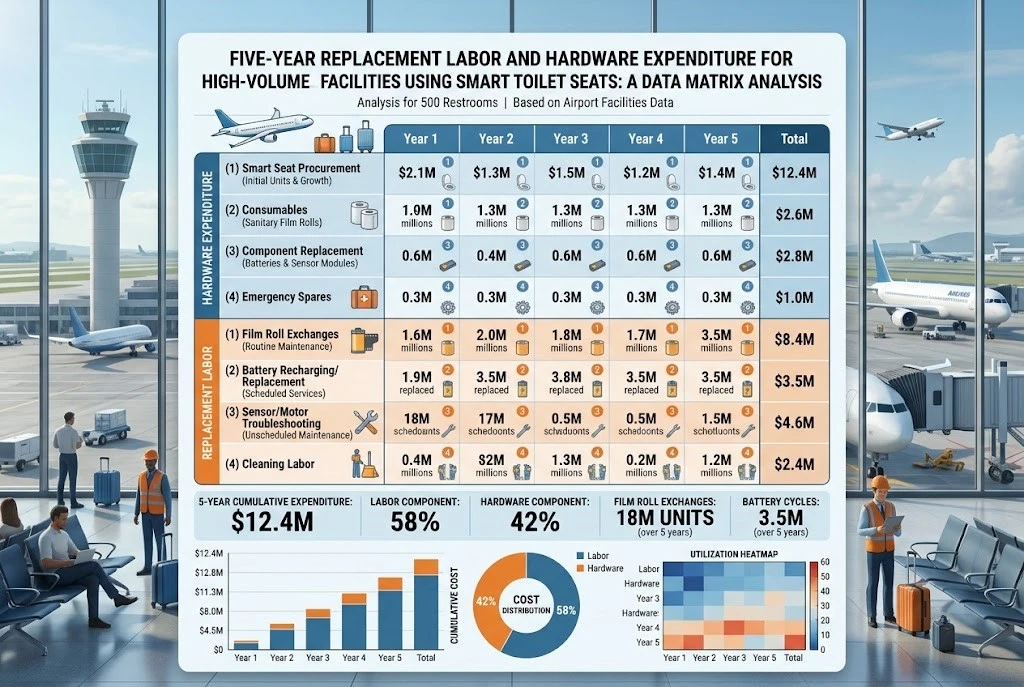
Labor Reduction
Replacing a dead automatic toilet seat battery requires a janitorial technician to unlock the housing, swap the pack, test sensor actuation, and return the depleted battery to a central charging station.
SLA Configuration
Requires replacement or external recharging every 30 to 45 days in high-traffic commercial environments (approx. 300 activations/day).
Lithium Configuration
Requires service every 120 to 180 days under identical usage patterns
Upgrading to high-capacity lithium configurations reduces maintenance labor by 40% over a 3-year facility budget cycle, freeing facility personnel for critical sanitation duties.
Battery Lifespan in Extreme Conditions
Commercial installations in transportation hubs, outdoor stadium facilities, or unheated public buildings encounter ambient temperature swings that affect battery performance
Cold Weather Performance
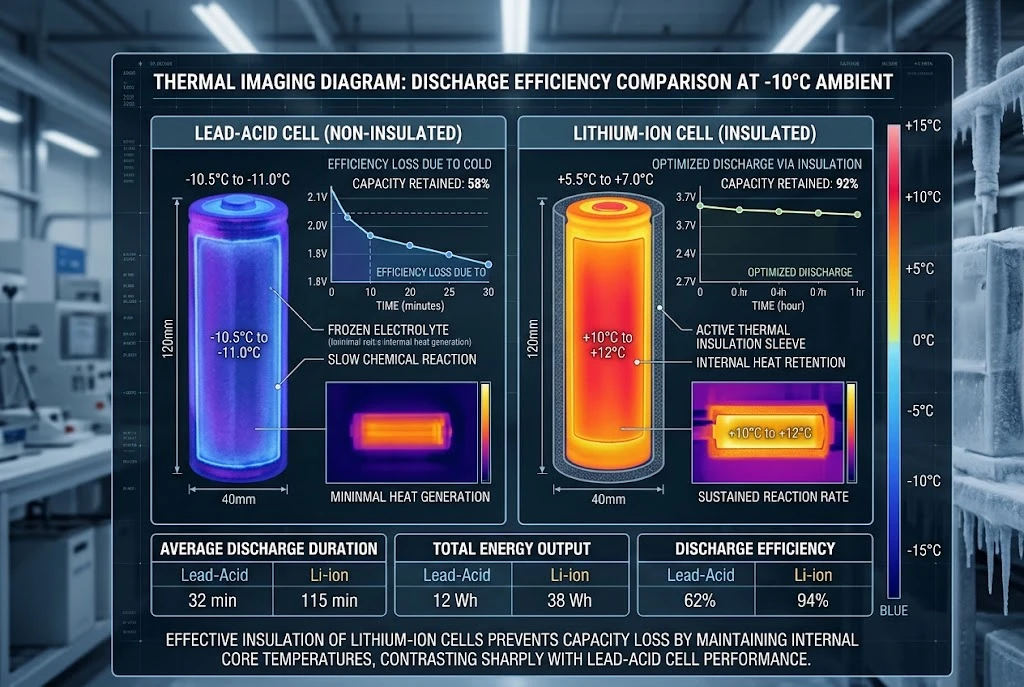
At temperatures below 0°C, internal resistance in SLA batteries increases dramatically, reducing effective capacity by up to 40%. Lithium packs utilizing built-in Battery Management Systems (BMS) retain 80–85% usable energy under identical cold conditions.
Thermal Degradation
High ambient temperatures accelerate internal grid corrosion in lead-acid cells, causing premature short circuits. Integrated BMS protection in lithium packs cuts off charging during thermal spikes, preserving internal chemistry.
Battery Lifespan in Extreme Conditions
Commercial installations in transportation hubs, outdoor stadium facilities, or unheated public buildings encounter ambient temperature swings that affect battery performance
Cold Weather Performance
At temperatures below 0°C, internal resistance in SLA batteries increases dramatically, reducing effective capacity by up to 40%. Lithium packs utilizing built-in Battery Management Systems (BMS) retain 80–85% usable energy under identical cold conditions
Thermal Degradation
High ambient temperatures accelerate internal grid corrosion in lead-acid cells, causing premature short circuits. Integrated BMS protection in lithium packs cuts off charging during thermal spikes, preserving internal chemistry.
OEM Power Customization and Manufacturing Capabilities
As a direct factory manufacturer, custom engineering allows matching power supplies to exact client facility specifications. Wholesale distributors and project contractors can leverage specific OEM options:
OEM / ODM FACTORY CUSTOMIZATION FLOW
| 1. Power Specs | 2. Enclosures | 3. Charging Tech | 4. Turnaround |
| Dual-slot LiFePO4 packs, 12V SLA | IP65 Sealed Casing, Tamper-proof | Direct DC Jack, Wall-Docking Bay | Prototype within 7 days |
| Custom Voltage Regulator | Snap-fit Quick Connectors | ABS+PC+Steel castings | Full OEM batch in 15 days |
Dual-Battery Swappable Modules
Designed for 24/7 commercial operations where downtime is unacceptable. Facilities charge one pack while the secondary pack powers the unit.
Integrated IP65 Sealed Housings
Custom battery enclosures engineered to withstand high-pressure water spray during deep restroom washdowns without moisture ingress.
Smart BMS Telemetry
Optional Bluetooth or IoT-enabled BMS boards that report battery voltage levels directly to central facility management dashboards.
Whether you require a standard automatic toilet seat battery solution or custom OEM packs built to project parameters, direct factory sourcing ensures component traceability, CE/RoHS compliance, and OEM customization within 15 days.
FAQ
Q: Do Low Ambient Temperatures In Cold Climates Shorten Automatic Toilet Seat Battery Lifespan?
A: Yes, extreme cold increases internal resistance, reducing usable capacity. Lead-acid batteries lose up to 40% of operational capacity below 0°C. Industrial lithium-ion cells with integrated Battery Management Systems maintain stable discharge voltage down to -20°C, preserving functional lifespan in unheated commercial facilities.
Q: What Is The Average Lifespan Of A Wholesale Commercial Automatic Toilet Seat Battery?
A: standard lead-acid battery lasts 12 to 18 months or roughly 300 to 500 charge cycles in commercial restrooms. Industrial lithium-ion (LiFePO4) options provided by original equipment manufacturers last 5 to 7 years, delivering over 2,000 cycles before requiring replacement.
Q: Can Custom Lithium-Ion Battery Packs Retrofits Fit Older Lead-Acid Smart Toilet Seat Models?
A: Yes, OEM manufacturers provide drop-in lithium replacement modules designed with matching form factors, terminal connections, and built-in step-down voltage regulators. These custom packs allow facilities to upgrade existing hardware to extended lithium power without replacing complete seat assemblies.
Q: What Certifications Should Facility Managers Look For When Sourcing Automatic Toilet Seat Batteries Wholesale?
A: Facility managers should verify CE, RoHS, UL2054, and UN38.3 transport certifications. These ratings ensure the battery chemistry withstands continuous charge cycles, complies with commercial building safety codes, prevents thermal runaway risks, and meets legal shipping standards for international B2B projects.
Contact us for a quote
Struggling with high maintenance costs, frequent battery replacements, and hardware downtime across your commercial restrooms? Contact our engineering team today to receive a detailed TCO comparison, review custom OEM/ODM power specifications, and request a functional sample unit for your project evaluation.


