


Designing ADA-Compliant Commercial Restrooms: Integrating Smart Sanitary Systems
High-traffic commercial restrooms present an ongoing challenge for facility managers: balancing strict accessibility mandates with hygiene maintenance and operational expense. Traditional paper covers often end up on floors or flushed down toilets, causing severe plumbing blockages and inflating daily janitorial costs.
Integrating automated smart toilet seats into ADA (Americans with Disabilities Act) compliant restroom layouts addresses both physical accessibility and operational efficiency. Touchless controls eliminate dexterity barriers for users with mobility limitations, while automated sanitary film systems ensure a fresh seat for every user without manual intervention
This guide details the technical requirements for specifying an ADA compliant smart toilet system, evaluating Total Cost of Ownership (TCO), and sourcing direct from an OEM manufacturer to meet strict project specifications.
ADA Compliance Standards and Smart Toilet Integration
Designing an accessible commercial restroom requires exact adherence to the 2010 ADA Standards for Accessible Design. Section 604 specifically governs water closets and toilet compartments, dictating seat height, clearance floor space, grab bar clearance, and flush control placement.
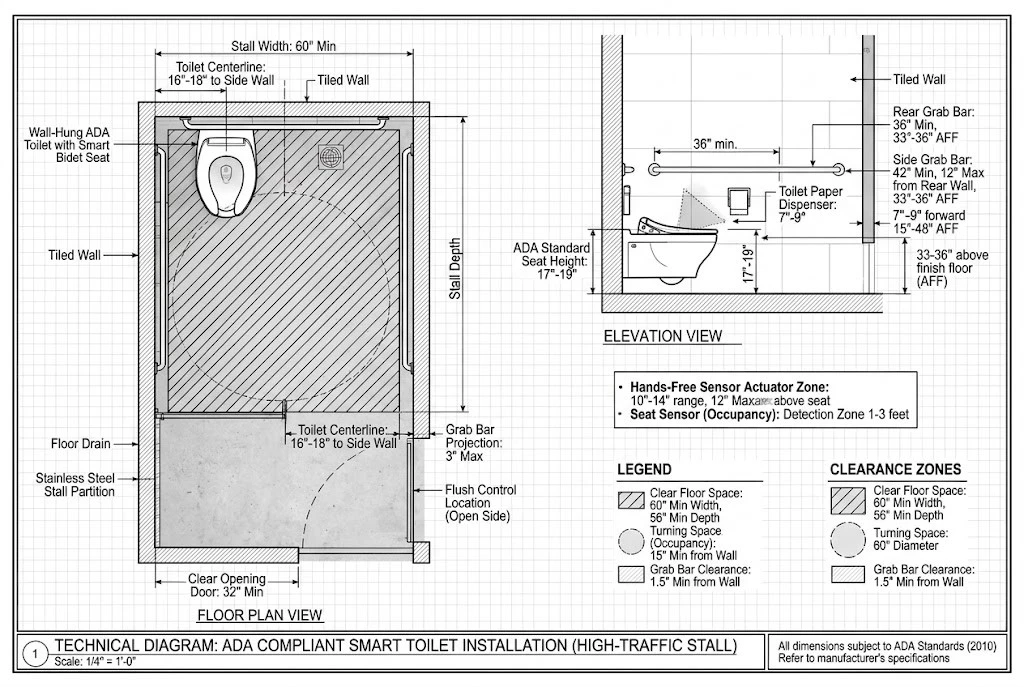
BACK WALL GRAB BAR | | (Min. 36" length, 33-36" AFF)
CENTERLINE OF TOILET16" - 18" FROM SIDE WALL
AUTOMATED SMART TOILET SEAT
(Height: 17" - 19" AFF)
CLEAR FLOOR SPACE
Min. 60" Wide x 56" Deep
Key Dimensional Constraints
Seat Height:
Flush toilet seats must be positioned 17 inches to 19 inches (430 mm to 485 mm) above the finish floor, measured to the top of the seat.
Control Location:
Controls for flush valves and automated features must be operable with one hand, require no tight grasping, pinching, or twisting of the wrist, and activate with a maximum force of 5 pounds (22.2 N).
Clear Floor Space:
A minimum 60 inches (1525 mm) wide by 56 inches (1420 mm) deep clear area must surround the water closet to allow adequate wheelchair transfer space.
Resolving Automated Feature Conflicts with ADA Requirements
1. Adding electronics or automated seat covers must not alter the required seat height range or obstruct required grab bar clearances.
2. Commercial smart seat attachments engineered for public facilities feature ultra-flat profiles (under 2 inches) to keep standard porcelain fixtures within the 17-to-19-inch height ceiling. Furthermore, side-mounted sensor buttons must sit within accessible reach zones-between 15 inches and 48 inches above the floor-if manual override options are included.
Evaluating Automated Sanitary Options for High-Traffic Restrooms
Facility managers managing airports, hospitals, office towers, and commercial centers routinely compare two primary seat hygiene solutions: automated sanitary film cover systems and conventional disposable paper seat covers.
Review recent commercial restroom case studies to see real-world performance metrics across major transport hubs.
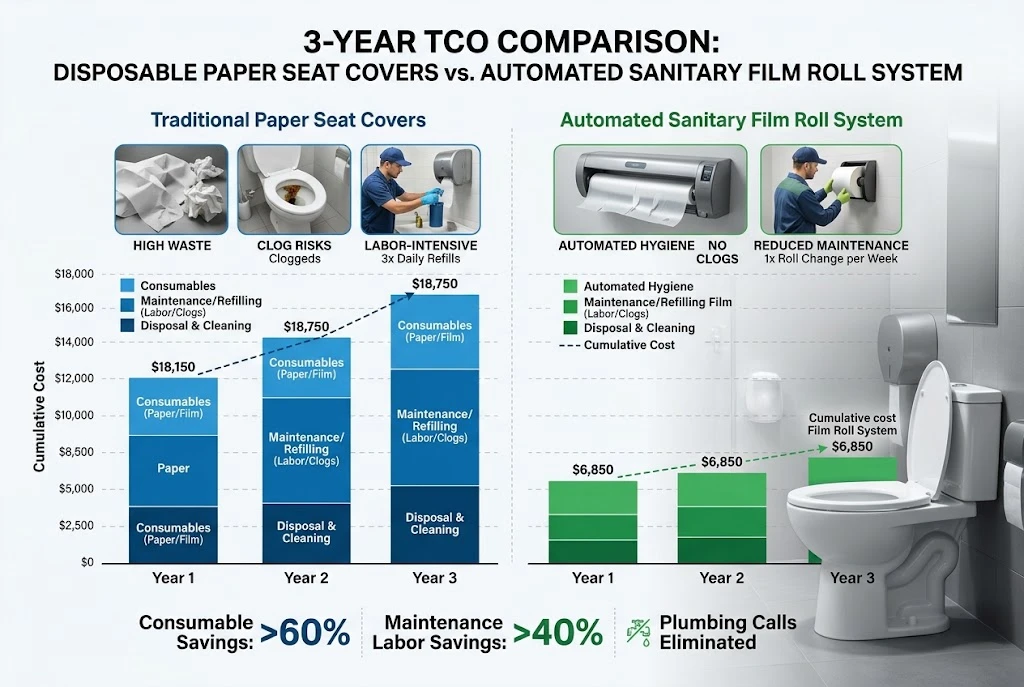
Operational Performance Metrics: Sanitary Film vs. Paper Covers
| Evaluation Metric | Automated Sanitary Film System | Conventional Paper Seat Covers | Impact on Restroom Operations |
| Initial Unit Cost | Medium ($120 - $220 per unit) | Very Low ($15 - $30 dispenser) | Capital expense offset within 6-9 months |
| Consumable Cost per Use | $0.012 - $0.018 per sleeve shift | $0.025 - $0.040 per sheet | Reduces direct consumable costs by 45%+ |
| Plumbing Risk (Clogs) | Zero (film is disposed of in internal compartment) | High (users frequently flush multiple sheets) | Saves an average of $1,200/year per 10 stalls in plumbing calls |
| Cross-Contamination Risk | Zero touch; fresh HDPE sleeve per user | High (manual placement and contact with sea | Meets strict international public hygiene standards |
| ADA Operability | Hands-free sensor or wave-activation | Requires manual extraction and unfolding | Full compliance with ADA Section 309 (Operable Parts) |
Engineering Specifications for Facility Procurement
When procuring hardware directly from a factory or seeking wholesale supply, technical procurement documentation must verify durability, safety certifications, and power management.
Sensor Activation and Touchless Operation Controls
Smart toilet seats in ADA stalls rely on optical infrared (IR) proximity sensors or microwave motion detectors.
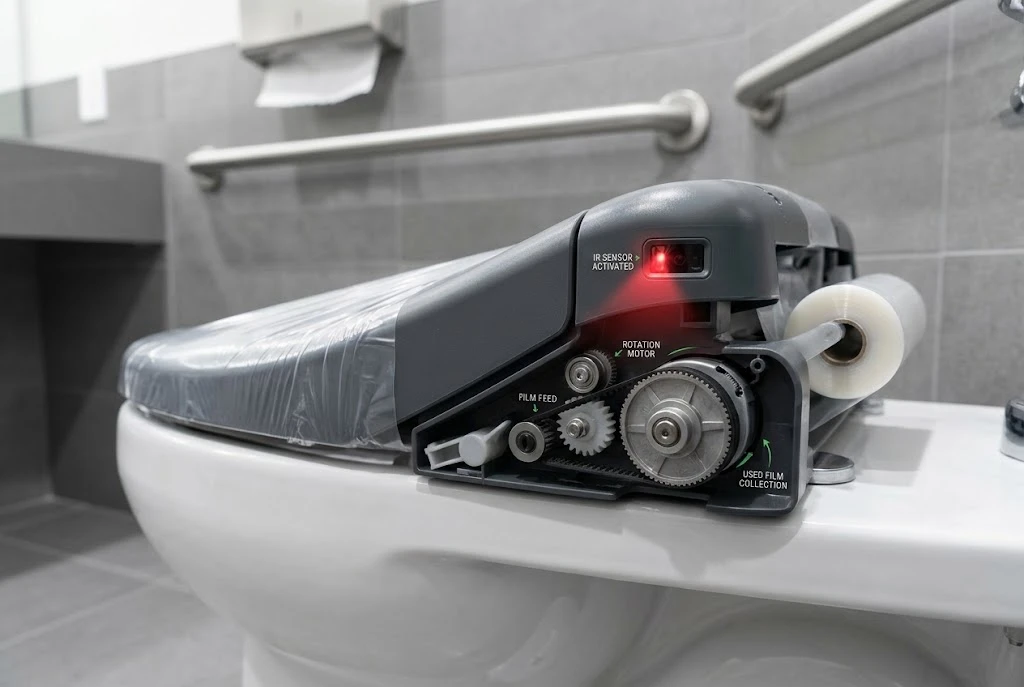
Micro-Motor Drive precision micro-motor drives the film rotation mechanism, advancing the High-Density Polyethylene (HDPE) film exactly one full circumference upon activation. Usage Lifespan: Commercial-grade units require a mechanical core rated for 10,000+ times usage lifespan under continuous daily operation. False-Trigger Mitigation: Sensors utilize timed lockouts (e.g., 6-second delay between activations) to prevent wasteful film consumption from accidental triggers.
Power Infrastructure: Battery vs. Hardwired InstallationsFacility managers must select the appropriate power configuration based on existing stall infrastructure: Rechargeable Lithium Battery Pack Ideal for retrofit projects without nearby electrical rough-ins. A standard 12V 4.5Ah lead-acid or rechargeable lithium battery provides up to 3,000+ times usage lifespan per charge, requiring recharging only once every 30-45 days under typical commercial traffic. Direct AC Hardwired Power Recommended for new construction. Operates via a standard 100V-240V AC transformer converted to step-down 12V DC power, eliminating battery maintenance entirely Sourcing OEM Customization and Wholesale ProcurementDirect-from-factory procurement allows facility distributors and engineering contractors to secure tailored product specifications. Partnering with a specialized manufacturer provides key advantages Customized Branding & Colors Private label printing on the seat cover housing and sanitary film packaging. Rapid Prototyping: Engineering adjustment for specialized bowl geometries with OEM customization within 15 days. Global Regulatory Compliance Certifications including CE, RoHS, and ISO9001 compliance for international commercial building tenders. Facilities seeking tailored hardware specifications can contact our engineering team to review options for OEM smart toilet seat factory customization. |
FAQ
Q: Does cold temperature affect the battery performance of automated sensor toilet seats?
A: Commercial-grade lithium battery packs operating in unheated public restrooms perform reliably down to -10°C (14°F). Below this threshold, discharge efficiency drops by approximately 15-20%, which may shorten the interval between required charges. For extreme cold environments, hardwired AC power configurations are recommended.
Q: Are sanitary film rolls eco-friendly and fully recyclable?
A: Yes. The sanitary film rolls are manufactured from high-density polyethylene (HDPE), a 100% recyclable thermoplastic resin. Used film rolls are kept completely isolated in a secondary internal compartment, allowing them to be collected, baled, and processed through standard commercial plastic recycling channels without contamination.
Q: How do automated smart seats prevent users from tearing or wasting the sanitary film?
A: The rotation mechanism utilizes a internal counter-blade that razor-cuts the used film as it rolls into the collection chamber. This structural modification prevents users from pulling, rewinding, or manually tampering with the film sleeve, ensuring the mechanism delivers exactly one sterile layer per activation cycle.
Q: Can an ADA compliant smart toilet seat fit standard commercial porcelain fixtures?
A: Yes. Commercial automated seats are designed using universal mounting hardware that fits both American Standard elongated and European standard standard porcelain toilets. The adjustable mounting bracket system allows fine-tuning during installation to maintain exact rim clearance within ADA spatial requirements.
Contact now for a quote
Struggling with high maintenance labor costs, persistent plumbing clogs, and strict compliance requirements in your commercial restrooms? Reach out to our engineering team today to receive a customized ROI and TCO analysis for your facility portfolio. Contact us now to request a free sample unit and evaluate our automatic sensor toilet seat systems for your next commercial project.


