


Evaluating the ROI of a Heated Toilet Seat Commercial Strategy for Premium Office Buildings

Facility management in Class A office buildings across cold-weather regions consistently battles tenant complaints regarding washroom comfort during winter months. Sub-optimal ambient temperatures in corporate restrooms directly drag down daily employee satisfaction metrics and tenant retention scorecards.
Deploying a temperature-controlled sanitary system shifts the restroom from a primary complaint zone to a measurable operational asset. High-end property managers now assess washroom upgrades strictly through the lens of return on investment (ROI) and building certification standards.
Implementing a heated toilet seat commercial solution addresses both physical comfort and hygienic expectations. Operations data indicates that upgrading core restroom fixtures directly supports WELL Building Standard requirements while minimizing manual maintenance labor.
Quantifying Employee Welfare and Building Certifications
Corporate tenants evaluate office spaces based on amenities that support their workforce. A cold restroom seat in a corporate tower during January creates immediate negative friction. Specifying a heated toilet seat commercial model mitigates this friction entirely. Upgraded washrooms act as a functional asset when negotiating lease renewals. Property managers utilizing these systems report higher internal satisfaction scores from enterprise tenants, specifically in regions experiencing prolonged freezing temperatures.
Operational Stability in High-Traffic Facilities

Commercial heating elements require different engineering than residential units. They must withstand continuous operation without catastrophic thermal failure or excessive electricity draw. Built-in thermal sensors maintain a constant 38°C (100.4°F) while defaulting to an eco-mode during off-peak night hours, restricting unnecessary power consumption.
TCO Analysis: Standard Seating vs. Thermostatic Sanitary Systems
When procuring fixtures, facility directors must calculate the Total Cost of Ownership (TCO). The data below compares standard passive setups with an automated thermostatic system equipped with sanitary film rolls.
|
Metric / Operational Category |
Standard Commercial Seats + Paper Covers |
NAVISANI Thermostatic Sanitary System |
|
Initial Procurement Cost |
Low |
Medium-High |
|
Winter Comfort Rating |
Low (Reflects ambient room temperature) |
High (Actively maintained at 38°C) |
|
Labor & Maintenance Hours |
High (Restocking paper, unclogging pipes) |
Reduces maintenance labor by 40% |
|
Consumable Waste Metrics |
5-8 paper covers per use (High wastage) |
1 exact sanitary film wrap per use |
|
Hardware Durability |
2-3 years before hinge/material failure |
10,000+ times usage lifespan tested |
Sourcing from a Direct Manufacturer: OEM and Wholesale Advantages
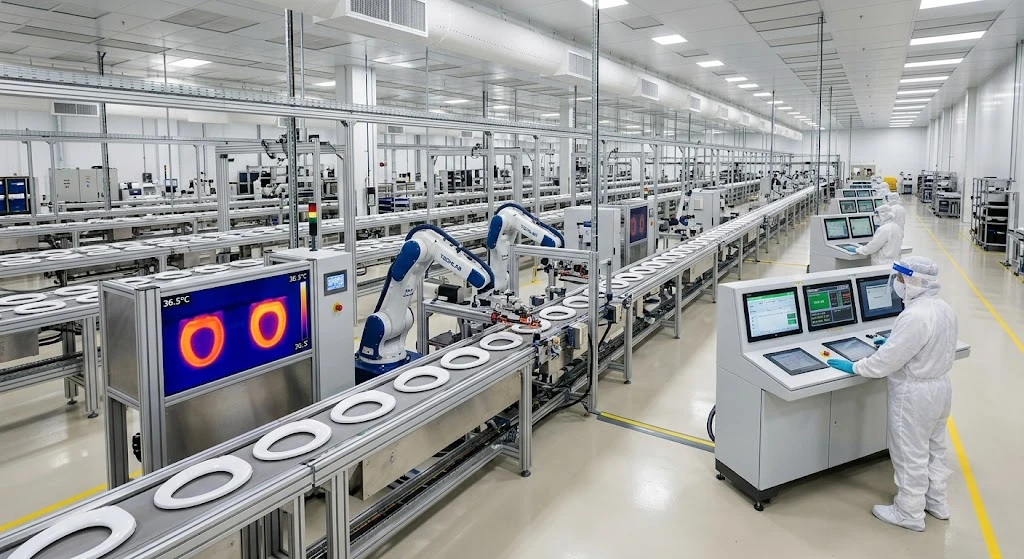
Working directly with a source factory eliminates intermediary markups and provides direct access to engineering support. For large-scale office park retrofits, partnering with a primary manufacturer guarantees consistent quality control and replacement parts availability.
We manage high-volume wholesale distribution and execute strict OEM customization within 15 days to match specific architectural hardware specifications. This direct supply chain allows procurement officers to lock in favorable unit economics while ensuring the hardware meets local CE and RoHS compliance standards.
FAQ
Q: Does the automatic film replacement system function reliably with the heated ring?
A: Yes. The thermal conduction is calibrated to penetrate the high-density PE sanitary film without melting or compromising the plastic's structural integrity. The heating element operates independently of the mechanical rolling system, ensuring steady temperature distribution without mechanical interference.
Q: What is the standby power consumption of commercial heated seats during non-office hours?
A: Units are equipped with a thermal eco-mode. During periods of non-use, typically overnight in commercial buildings, the seat drops its temperature baseline, consuming less than 0.05 kWh per night. This metric heavily limits annual utility expenditures.
Q: Can the heating temperature be capped to meet specific facility safety regulations?
A: The default firmware caps the maximum surface temperature at 38°C (100.4°F) to prevent low-temperature burns. Custom thermal settings can be programmed for OEM orders to meet specialized municipal safety codes or strict hospital-grade requirements.
Q: What is the standard lead time for OEM bulk orders of heated commercial seats?
A: For standard wholesale orders, dispatch occurs within 7-10 business days. For customized OEM modifications, including specific voltage adjustments or logo branding, the factory processing timeline is completed within 15 days following final prototype approval.
Contact now for a quote
Struggling with high maintenance costs and low tenant satisfaction in your commercial restrooms? Reach out to our engineering team for a customized ROI analysis and request a free sample of our heated automatic sensor toilet seat systems today.


