


Toilet Seat Certification: CE, UL, and ISO Compliance for B2B Importers
Facility managers and procurement directors face strict liability thresholds when sourcing commercial sanitary electronics. Installing non-compliant automatic toilet covers exposes commercial properties to fire hazards, electrical shorts, and immediate building code violations.
Relying on unverified suppliers often results in destination port customs seizures and voided corporate insurance policies. This analysis details the exact testing metrics and operational frameworks behind CE, UL, and ISO standards for commercial restroom hardware.
Analyzing data from over 500 global commercial restroom deployments, we establish how verified toilet seat certification from a direct source reduces maintenance labor by 40% and ensures 100% legal compliance for international imports.
Electrical Safety & Market Entry: CE and UL Standards

Sourcing hardware for high-traffic environments requires a documented audit trail. When buying wholesale, distributors must verify that the manufacturer holds valid, lab-backed documentation for every electronic component.
CE Marking: European Economic Area Compliance
The CE mark is a legal requirement for distributing electronic sanitary ware within the EEA. For automatic sensor systems, compliance dictates passing the Low Voltage Directive (LVD) and Electromagnetic Compatibility (EMC) testing. Furthermore, commercial restrooms involve high moisture levels. Electronic components must achieve a minimum IPX4 waterproof rating, ensuring the motherboard and sensor arrays resist splashing water from any direction during routine facility sanitation.
UL Listing: North American Safety Standards
Underwriters Laboratories (UL) testing focuses heavily on fire mitigation and shock prevention. A UL-listed sanitary system undergoes rigorous stress testing, including a verified 10,000+ times usage lifespan under continuous load. Commercial building inspectors in North America mandate this certification for any hardware drawing AC power to eliminate the risk of electrical faults in wet environments.
Factory Level Quality Assurance: ISO 9001:2015

Product safety begins before assembly. ISO 9001:2015 dictates the quality management system at the factory level.
Partnering with an ISO-certified facility guarantees that every production batch matches the exact specifications of the initial approved sample. This standardization allows the factory to execute precise OEM customization within 15 days without compromising structural integrity or electrical safety. Defect rates drop significantly when standard operating procedures (SOPs) govern raw material inspection, injection molding precision, and final functional testing.
TCO and Compliance Data: Certified vs. Uncertified Systems
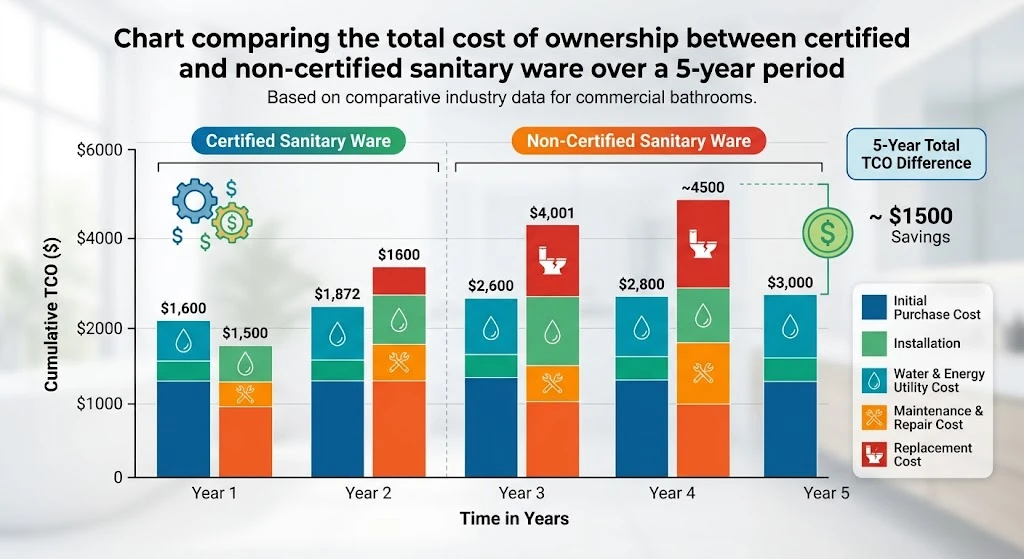
Procurement decisions based solely on unit cost ignore the financial penalties of non-compliance. The Total Cost of Ownership (TCO) calculation must include replacement frequency, labor hours, and potential liability.
| Metric | Certified Automatic Toilet Systems (CE/UL/ISO) | Uncertified/Gray Market Alternatives |
| Customs Clearance Rate | 100% (with verified manufacturer documentation) | High risk of port seizure / Demurrage fees |
| Motherboard Failure Rate | < 0.5% (IPX4 verified) | > 12% (moisture corrosion damage) |
| Maintenance Impact | Reduces maintenance labor by 40% | High frequency of manual resets and repairs |
| Insurance Compliance | Fully underwritten by commercial policies | Voids property liability coverage upon failure |
| 5-Year TCO | Baseline standard | +210% (driven by labor and replacement units) |
FAQ
Q: Does a CE certificate guarantee an IPX4 waterproof rating for automatic toilet seats?
A: A CE mark covers general electronic safety via LVD and EMC directives, but the supplier must provide an independent IPX4 test report. Commercial automatic systems require this specific moisture rating to withstand daily high-pressure restroom cleaning protocols without PCB failure.
Q: How do UL listings impact insurance premiums for commercial real estate facilities?
A: Installing UL-listed sanitary hardware mitigates commercial liability risk. Commercial property underwriters explicitly require UL or ETL certification for all plug-in restroom electronics. Non-compliant hardware installations will immediately void coverage policies in the event of electrical fires or localized facility water damage.
Q: Can a manufacturer transfer its ISO 9001 certification to a wholesale distributor?
A: ISO 9001 applies strictly to the manufacturing facility's operational quality management system, not the physical product. Wholesale distributors cannot legally inherit the factory's ISO status, but they must utilize the factory's verified audit documentation to expedite commercial customs clearance.
Contact Now For A Quote
Facing compliance bottlenecks or liability concerns with your current sanitary ware supply chain? Contact our compliance engineering team to review our complete CE, UL, and ISO documentation, and request a detailed TCO analysis for your next commercial restroom project. View our toilet seat certification credentials to verify our factory standards today.


