


Smart Bathroom IoT: Remote Monitoring for Commercial Facilities
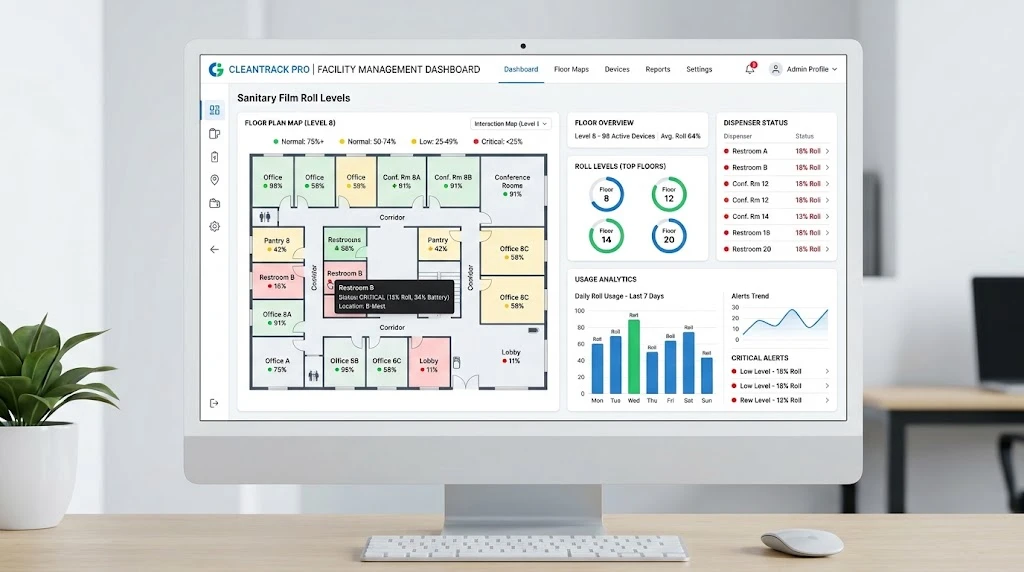
Facility managers overseeing high-traffic properties face persistent challenges with consumable tracking and preventive maintenance, leading to unexpected outages and excessive janitorial labor costs. Relying on manual inspections to verify sanitary film levels or diagnose motor faults results in high operational expenditures and frequent user complaints.
The integration of smart bathroom IoT shifts operations from reactive troubleshooting to data-driven facility management, providing precise, real-time oversight of hardware status. Implementing remote monitoring networks directly addresses these inefficiencies, optimizing janitorial routing based on actual hardware usage data.
Empirical data from recent commercial deployments shows that automated alerts for consumable depletion reduces maintenance labor by 40%. By eliminating the guesswork associated with daily inspection routes, procurement directors can accurately forecast maintenance budgets and improve overall facility hygiene standards.
The Financial Impact of Smart Bathroom IoT on Maintenance

Managing a network of hundreds of commercial cubicles requires exact data. By sourcing hardware directly from a certified factory, facilities can integrate Wi-Fi or LoRaWAN-enabled automatic toilet seats directly into their existing property management software. This direct data feed allows logistics directors to monitor the total cost of ownership (TCO) in real-time, tracking exactly how many times a sanitary roll has been actuated and when the internal battery requires recharging.
Automated Film Roll Depletion Alerts
The core advantage of remote monitoring is the early warning system for consumable capacity. Traditional management protocols require staff to visually check each cubicle, often resulting in premature roll replacement to avoid mid-day outages. IoT sensors trigger an automated dashboard alert when a sanitary film roll reaches 10% capacity.
This precision optimizes inventory management, allowing procurement teams to adjust their wholesale purchasing cycles based on exact usage metrics rather than historical estimates.
Data-Driven Hardware Reliability and Integration

Partnering with an established manufacturer ensures that telemetry sensors are engineered directly into the motor housing without compromising the physical durability of the unit. These commercial-grade automated seats maintain a 10,000+ times usage lifespan, with IoT modules continuously reporting motor health to prevent sudden mechanical failures.
For facilities requiring specific architectural alignment, working with the source facility allows for OEM customization within 15 days, ensuring the smart units match both the aesthetic and technical specifications of the building.
| Operational Metric | Traditional Washroom Management | Smart Bathroom IoT Integration | TCO Impact |
| Consumable Tracking | Manual visual inspections | Real-time depletion alerts | Eliminates 30% of premature waste |
| Maintenance Routing | Fixed hourly schedules | Actuation-based targeted routing | Reduces maintenance labor by 40% |
| Downtime Response | Reactive (post-complaint) | Predictive motor fault alerts | 90% faster repair response time |
| Procurement Strategy | Estimated monthly bulk ordering | Data-driven wholesale forecasting | Prevents capital lockup in excess inventory |
FAQ
Q: How does an IoT-enabled toilet seat transmit data in commercial buildings with weak Wi-Fi?
A: Commercial units utilize low-power wide-area networks (LPWAN) or LoRaWAN protocols, requiring minimal bandwidth. This guarantees stable transmission of battery and film roll telemetry to the central dashboard, bypassing localized Wi-Fi dead zones common in heavy concrete structures.
Q: What is the TCO impact of adding remote monitoring modules to automatic seat covers?
A: While the initial hardware investment increases by 12-15%, commercial facilities recover this premium within eight to ten months. The ROI is driven directly by a 40% reduction in janitorial auditing hours and the exact optimization of sanitary film roll usage.
Q: Are IoT washroom sensors compliant with CE and RoHS data privacy standards?
A: Yes. Industrial-grade smart bathroom IoT systems track mechanical hardware actuation and consumable levels, capturing zero personal user data. All hardware processing units comply strictly with RoHS manufacturing standards and regional data anonymity regulations.
Contact Now For A Quote
Struggling with high maintenance costs and inefficient consumable tracking in your commercial restrooms? Reach out to our engineering team for a customized ROI analysis and request a free sample of our automated sensor toilet seat systems today to evaluate the financial impact on your facility operations.


