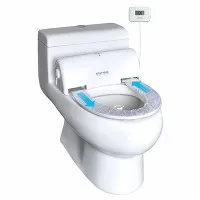
Paper toilet covers in public restrooms exhibit measurable inefficiencies: waste rates exceed 18–35%, plumbing blockage probability reaches 8–12% under peak load, and recurring labor cleaning cycles average every 2–4 hours. For high-traffic facilities (>800 uses/day), total lifecycle cost often surpasses fixed smart seat installation within 14–22 months.
1. Leakage & Structural Failure Rate (18–35% Waste Ratio)
Paper covers rely on low GSM pulp (typically 16–22 g/m²), which leads to structural instability when exposed to humidity (>70% RH).
Key Engineering Observations:
- Tensile strength: < 1.8 kN/m (ISO 1924-2)
- Water absorption time: < 3 seconds before deformation
- Failure rate during placement: 18–35% (field data from transit hubs)
Cost Impact:
- Average consumption per user: 1.4–1.8 sheets
- Waste escalation factor: +40% vs theoretical usage
|
Parameter |
Paper Covers |
Smart Toilet Seat |
|
Unit Consumption |
1.4–1.8 pcs/use |
0 pcs |
|
Failure Rate |
18–35% |
0% |
|
Replacement Frequency |
Continuous |
3–5 years lifecycle |
2. Plumbing Blockage & Maintenance Cost (8–12% Risk)
Paper covers are often flushed despite "non-flushable" labeling. Under high-frequency usage, cellulose accumulation increases blockage probability.
Measured Data:
- Pipe diameter sensitivity: < DN100 systems most affected
- Blockage occurrence: 8–12% monthly in >500 uses/day facilities
- Clearance cost per incident: USD 80–250 (regional variance)
Engineering Mechanism:
- Fiber dispersion incomplete (non-toilet-grade pulp)
- Sedimentation in low-slope piping (<1.5%)
Annual Cost Estimate (Single Facility):
|
Metric |
Value |
|
Monthly blockage events |
3–6 |
|
Avg repair cost/event |
$120 |
|
Annual maintenance cost |
$4,320–$8,640 |
3. Manual Cleaning Labor Load (2–4 Hour Cycles)
Paper covers frequently miss the seat or fall to the floor, increasing janitorial workload.
Operational Data:
- Cleaning frequency: every 2–4 hours
- Time per cleaning cycle: 6–12 minutes per restroom
- Labor cost benchmark: $12–25/hour (global average range)
Cost Model:
|
Factor |
Value |
|
Daily cleaning cycles |
6–10 |
|
Time per day |
60–120 min |
|
Monthly labor cost |
$360–$1,200 |
Request Bulk Pricing for Toilet Seat Systems
Replace consumables with fixed assets: wholesale Toilet seat
4. User Behavior Waste Amplification (Overuse Factor 1.4–2.0x)
End-user behavior significantly increases consumption due to perceived hygiene risk.
Observed Patterns:
- Double layering rate: 42%
- Improper placement discard rate: 15–22%
- Full bypass (no use): 25% (indicates inefficiency of system itself)
Result:
- Actual usage exceeds forecast by 40–100%
- Procurement forecasting error margin: ±35%
5. Supply Chain & Inventory Cost Volatility
Paper covers require continuous replenishment, introducing logistics complexity.
Supply Chain Metrics:
- MOQ typical: 50,000–100,000 pcs
- Storage volume: 0.8–1.2 m³ per 10,000 units
- Lead time (China manufacturer): 20–35 days
Cost Variables:
- Freight fluctuation: ±18% (post-2023 volatility)
- Warehouse handling: $0.02–0.05/unit
|
Cost Component |
Paper Covers |
Smart Seat OEM |
|
Inventory Turnover |
High |
Low |
|
Logistics Frequency |
Monthly |
One-time + spare parts |
|
Price Stability |
Low |
Contract-fixed |
Engineering Alternative: Smart Toilet Seat (Fixed Asset Model)
Replacing disposable covers with smart toilet seats eliminates recurring variables.
Typical Technical Specifications:
- Seat material: PP antibacterial (ISO 22196)
- Load capacity: ≥150 kg (EN 997 compliant)
- Heating power: 45–60W
- Lifecycle: 30,000–50,000 cycles
Explore full product configurations: wholesale Toilet seat


FAQ
Q: What is the MOQ for OEM smart toilet seats from a China manufacturer?
A: Standard MOQ ranges from 200–500 units per model. Custom branding or mold modification may require ≥1,000 units.
Q: How does lifecycle cost compare between paper covers and smart seats?
A: Smart seats typically reach cost parity within 14–22 months in high-traffic restrooms (>800 uses/day).
Q: What certifications are required for international projects?
A: Common requirements include CE (LVD/EMC), RoHS, IPX4 waterproof rating, and ISO 9001 factory audit compliance.