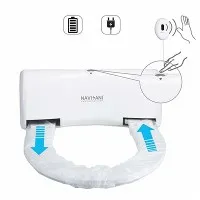
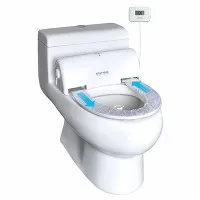
Facility managers consistently face escalating labor costs associated with maintaining high-traffic commercial restrooms. Traditional paper seat covers lead to severe plumbing blockages and demand excessive janitorial labor for restocking and floor cleanup.
Automatic sanitary cover systems eliminate these specific plumbing bottlenecks, yet procurement directors frequently scrutinize the ongoing maintenance requirements of the actual hardware.
This guide details the exact operational protocol to replace toilet seat film rolls in under 30 seconds, providing baseline data to optimize your facility's Total Cost of Ownership (TCO) and reduce immediate janitorial labor hours by up to 40% per quarter.
Baseline Metrics for Consumable Management
Before examining the physical replacement process, it is strictly necessary to understand the hardware and consumable parameters. Sourcing hardware and refills guarantees specific performance metrics. Our standard automatic systems feature motors tested for a 10,000+ times usage lifespan.
A standard wholesale sanitary film roll provides exactly 130 to 135 clean uses. This highly predictable consumption rate allows logistics directors to forecast purchasing cycles with extreme accuracy, preventing both stockouts and excess inventory warehousing in commercial facilities.
The 30-Second Replacement Protocol

Minimizing downtime per cubicle dictates overall labor efficiency. The engineered design allows janitorial staff to execute the swap rapidly with minimal training.
Open the Dispenser Housing (0-5 Seconds): Insert the proprietary maintenance key to release the secure top cover. This tamper-proof design protects the internal mechanisms in high-risk public environments.
Extract the Depleted Core (5-10 Seconds): Lift the used plastic take-up reel from the right-side motorized gear. Discard the compacted used material according to your local commercial waste protocols.
Load the New Roll (10-20 Seconds): Place the fresh roll onto the left-side passive axis. Pull approximately 30 centimeters of the material across the seat ring.
Secure and Calibrate (20-30 Seconds): Thread the leading edge into the slot of the new empty take-up reel. Place the reel onto the motorized gear. Close the main housing until it clicks, and press the manual activation button once to verify the optical sensor alignment.
Total Cost of Ownership (TCO) & Labor Analysis
Transitioning from analog paper products to automated film systems fundamentally alters the maintenance cost structure. The data below reflects average operational expenditures in high-traffic environments (e.g., transit hubs, Class A office buildings).
| Cost Metric (Per 1000 Uses) | Traditional Paper Seat Covers | Automatic Sanitary Film System |
| Restocking Frequency | High (Every 2-3 hours) | Low (Every 130 uses) |
| Plumbing Clog Incidence | 4.2 incidents / month | 0 incidents / month |
| Janitorial Labor Time | 45 minutes / week | 5 minutes / week |
| Material Cost per Use | $0.015 (High waste variance) | $0.021 (Strictly controlled) |
| Total ROI Timeline | N/A | 3.5 - 5 Months |
OEM Customization and Supply Chain Reliability

For large-scale deployments in international airports or hospital networks, standard off-the-shelf solutions often fail to align with specific procurement constraints. Partnering directly with the manufacturer allows for OEM customization within 15 days.
This capability includes adjusting roll lengths for non-standard housing dimensions or utilizing specific HDPE material grades that meet strict regional CE/RoHS compliance standards. Relying on a source factory ensures supply chain stability and locks in favorable pricing structures for high-volume contracts.
FAQ
Q: Does extreme cold affect the dispensing speed of the sanitary film?
A: High-quality HDPE film rolls maintain their tensile strength and flexibility down to -10°C. However, the 6V DC motors powering the dispensing mechanics require stable battery output, which may experience a 10-15% voltage drop in unheated, freezing commercial restrooms.
Q: Are factory-direct HDPE film rolls legally recyclable?
A: Yes. The material is manufactured from high-density polyethylene (HDPE), categorized under recycling code 2. Facilities can aggregate the depleted rolls and process them through standard commercial plastic recycling streams, supporting corporate ESG compliance targets.
Q: How do wholesale procurement scales impact the defect rate?
A: Procuring directly from a primary factory ensures rigorous QA testing. Automated production lines maintain a defect rate strictly below 0.02%. Each batch undergoes optical tension testing to prevent material tearing during the motorized take-up sequence.
Contact now for a quote
Struggling with escalating maintenance costs and unsanitary conditions in your commercial restrooms? Reach out to our engineering team for a customized ROI analysis, and request a free sample of our automatic sensor toilet seat systems today to evaluate the labor reduction firsthand.