


Toilet Plume Prevention Commercial: The Financial and Hygienic Case for Automatic Covers
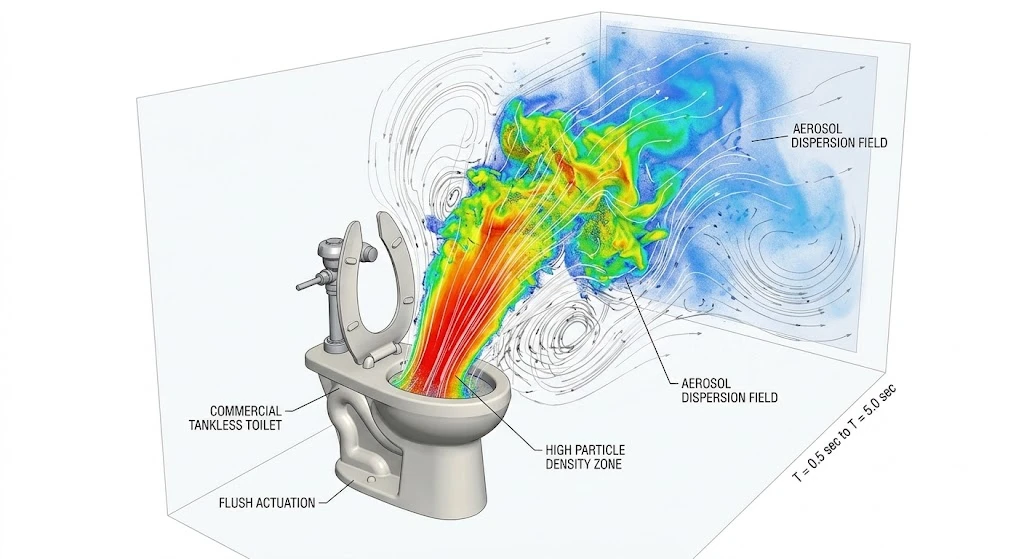
Facility managers operating high-traffic environments-airports, hospitals, and Class-A office buildings-face compounding maintenance challenges. While visible waste is quickly addressed, the invisible threat of aerosolized bacteria generated during high-pressure flushes creates widespread surface contamination. This dynamic increases both the facility's infection liability and the labor hours required for deep cleaning.
Implementing structural toilet plume prevention commercial protocols requires moving beyond manual user interventions. The scientific consensus dictates that capturing flush aerosols at the source is the only statistically valid method of control. This analysis evaluates the mechanics of flush-induced contamination and the direct ROI of deploying automatic cover systems at scale.
The Mechanics of Flush Aerosol Contamination

When a standard commercial flushometer activates, it utilizes high water pressure to clear the bowl. Without a physical barrier, this kinetic energy ejects microscopic water droplets containing fecal bacteria, norovirus, and other pathogens up to 1.5 meters into the ambient air. These suspended particles remain airborne for extended periods before settling on adjacent surfaces, including flush buttons, grab bars, partition door handles, and tissue dispensers.
Relying on transient users to manually close traditional lids yields a compliance rate near zero, as patrons actively avoid touching public restroom surfaces. Automatic seat covers remove the human variable from this hygiene equation. By utilizing motion sensors or weight-activated mechanical triggers to close the lid prior to or immediately following the flush cycle, these systems physically intercept the plume.
TCO Analysis: Open Standard Seats vs. Automatic Covers
Procurement teams must evaluate sanitary hardware through the lens of Total Cost of Ownership (TCO) rather than isolated unit costs. High pathogen loads on restroom surfaces force janitorial staff to execute time-intensive chemical wipe-downs of all cubicled hardware multiple times a day.
Containing the plume directly translates to operational efficiency. Field implementation data indicates that physically blocking aerosol spread reduces required surface disinfection time, which effectively reduces maintenance labor by 40% across high-density commercial restrooms.
| Specification & Impact Matrix | Standard Open Seats | Automatic Sensor Covers | Financial / Operational Impact |
| Aerosol Containment | 0% (Full Plume Exposure) | > 95% (Physical Barrier) | Drastic reduction in cross-contamination liability. |
| User Compliance | Minimal (< 5%) | 100% (Automated action) | Removes user behavior from the hygiene protocol. |
| Maintenance Labor | High (Frequent surface wiping) | Low (Confined to bowl interior) | Reallocates janitorial hours to other facility zones. |
| Component Lifespan | 12 - 18 months (Hinges fail) | 10,000+ times usage lifespan | Commercial-grade dampeners prevent slamming and hardware fractures. |
| Power Requirement | None | Battery / AC / Non-Electric | Selectable based on existing facility infrastructure. |
Supply Chain Dynamics: Sourcing from a Direct Manufacturer

For large-scale commercial deployments, working through a tiered distribution network inflates capital expenditure and delays project timelines. Sourcing directly from a specialized factory provides procurement directors with strict quality control and logistical predictability.
A qualified wholesale manufacturer engineers their automatic covers to meet stringent CE and RoHS international standards, ensuring the electronic and mechanical components withstand the heavy abuse typical of public environments. Furthermore, direct factory partnerships enable specific adaptations for unique commercial ceramics. A capable facility offers OEM customization within 15 days, allowing project managers to match exact mounting dimensions, sensor sensitivities, and branding requirements without delaying the broader construction or renovation schedule.
FAQ
Q: How far can a toilet plume travel in a standard commercial restroom?
A: Depending on the flush valve pressure, aerosols can be projected up to 1.5 meters (nearly 5 feet) vertically and horizontally. This radius easily encompasses all adjacent touchpoints within a standard ADA-compliant commercial restroom stall, including paper dispensers and handrails.
Q: Do automatic covers require extensive electrical retrofitting?
A: Not necessarily. While hardwired AC models exist for new builds, many commercial units operate on high-capacity lithium battery packs that last up to 12 months. Additionally, advanced non-electric kinetic models utilize hydraulic or mechanical weight-displacement to trigger the lid closure.
Q: How does containing the toilet plume impact facility HVAC systems?
A: By trapping aerosols within the bowl housing, automatic covers prevent high volumes of airborne moisture and bacterial particulate from being drawn into the restroom's exhaust vents. This reduces the bio-load on HVAC filters and prevents ductwork contamination.
Contact Now For A Quote
Managing infection control and high maintenance overhead in your commercial facilities? Reach out to our engineering team for a customized ROI analysis based on your foot traffic data. Request a technical specification sheet or inquire about our wholesale sampling program for heavy-duty automatic toilet cover systems today.


